Read an energy-product quote beyond the product price
Compare the assessment, product, fitting and support included in an energy-product proposal before comparing its total.
Updated:

Read the scope before the total
Two quotations can have different totals because they include different work. Before deciding which is cheaper, write down the product, location and intended outcome for each proposal. A supply-only item and an assessed installation are not equivalent purchases. Ask the supplier to identify anything provisional or excluded. This guide does not provide a market price, negotiate a contract or assess a particular installer. It offers a way to make the comparison understandable, so a missing service or unresolved technical question does not disappear behind a prominently displayed dollar amount.
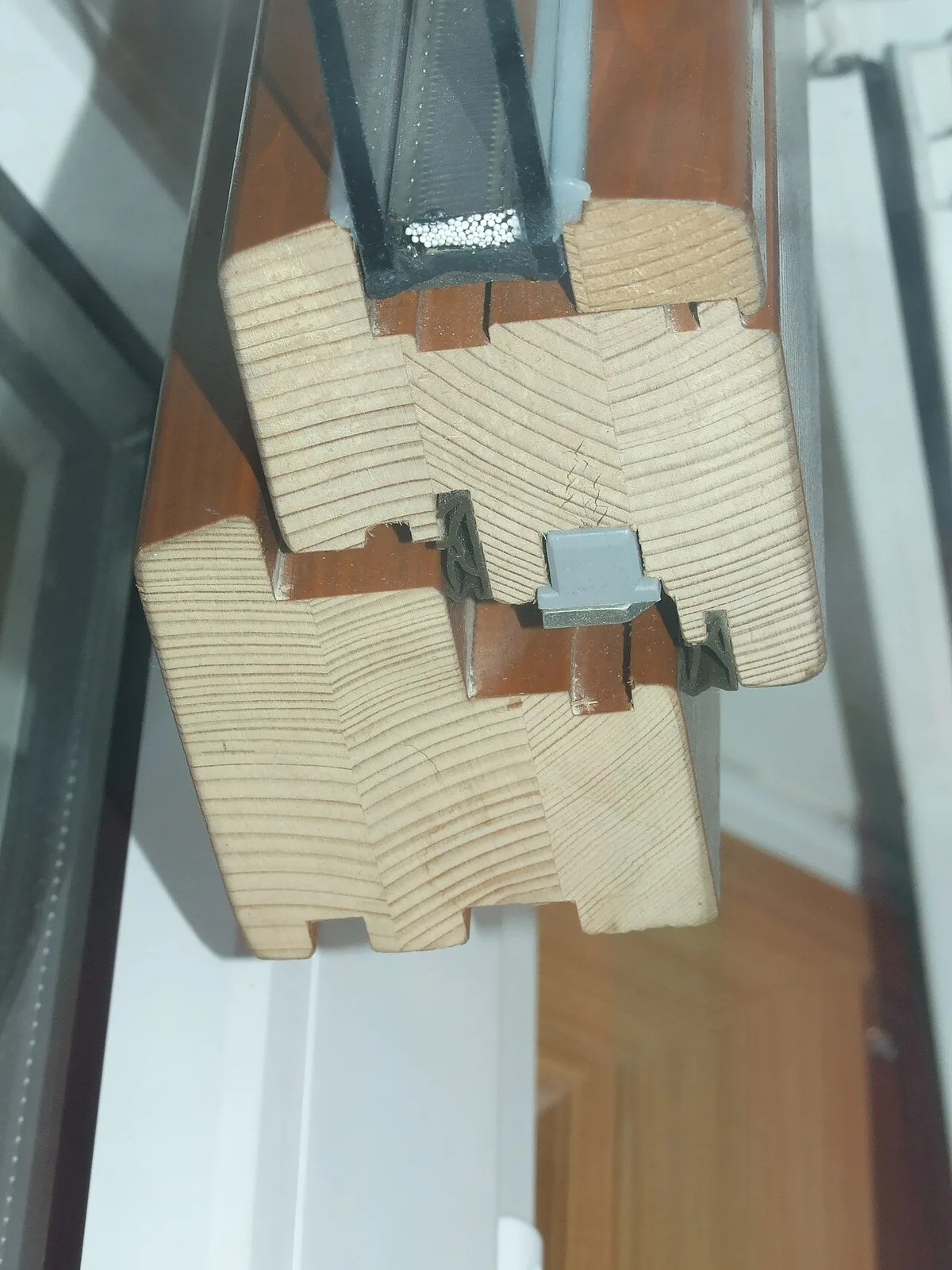
Keep the exact product connected to the window
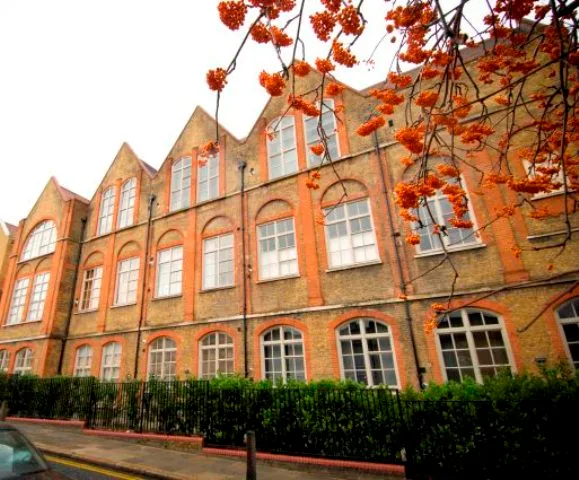
For a film proposal, retain the exact product identification and the window schedule to which it applies. Your Home discusses glazing properties and film suitability, while WERS For Film describes a rating and accreditation framework. Ask which documentation supports the actual proposal rather than accepting a general statement about a brand. The cutaway photograph shows a window assembly, and the casement photograph shows multiple openings. Neither establishes that every pane in your home is identical. A quote should make clear which locations have been assessed and which still require confirmation.
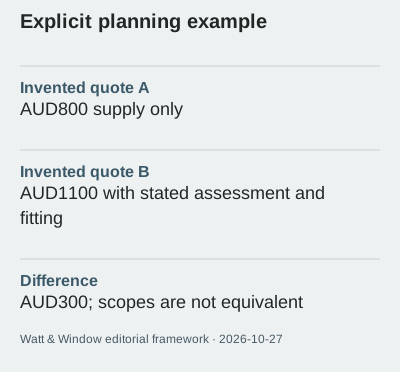
Use an invented example to expose the difference
Imagine quote A lists AUD800 for supply only, while quote B lists AUD1100 with a stated assessment and fitting scope. Relative to AUD800, the additional AUD300 is 37.5%, but the different scopes still prevent an equivalent-price comparison. The numerical difference is AUD300, but it is not automatically a saving available by choosing A. The scopes differ, and additional requirements remain unknown. If A later adds AUD400 of necessary work, its revised total would be AUD1200 in this invented example. These numbers are not current prices. Their purpose is to show why a comparison should preserve exclusions and additions instead of treating the first visible total as the complete cost.
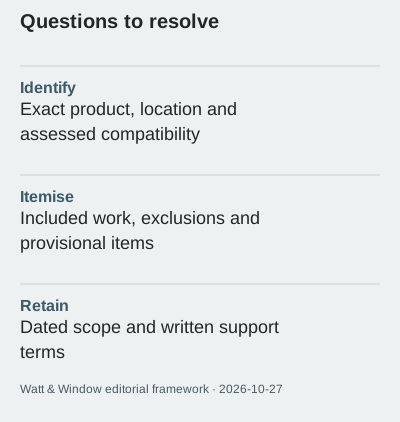
Ask for the boundaries of the work
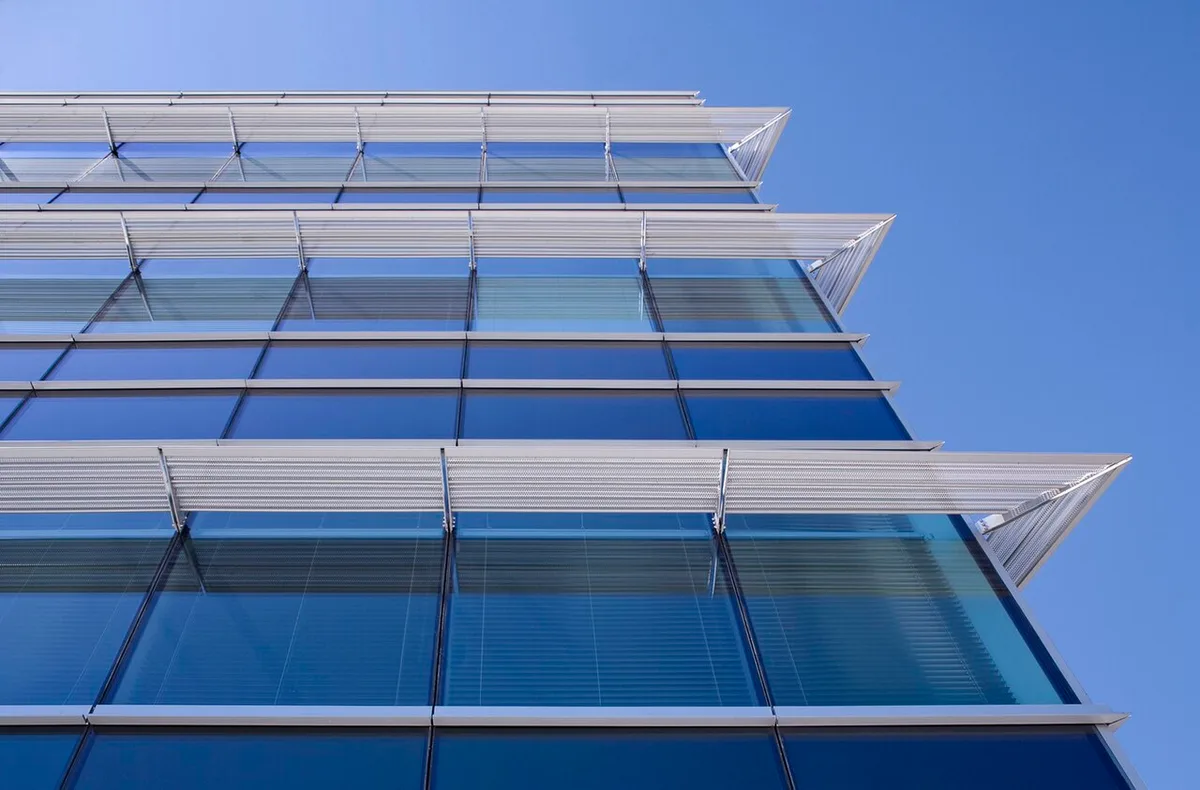
Request a plain description of assessment, preparation, access, fitting and any follow-up included in the proposal. Do not assume every project needs the same items or that a standard allowance covers them. Ask how changes discovered during assessment would be documented before proceeding. External shading, illustrated in the office photograph, is a separate type of intervention and should not be silently bundled into a film comparison. Keep alternative scopes separate, even when they address the same room concern. This helps you understand what each supplier is actually offering.
Read written support terms for the exact proposal
Ask who handles questions or defects and request the current written warranty terms for the specified product and work. Record relevant conditions without inventing a standard coverage period. A broad marketing promise is not a substitute for the actual terms. Keep any compatibility assessment with those documents, especially where an existing window or coating matters. This article does not interpret legal rights or state that a warranty replaces them. If a term is unclear or disputed, seek the appropriate official consumer guidance or professional advice for the situation rather than relying on a generic summary.
Make a comparison that survives a revision
Our source review date is 2026-10-27. Give every quotation and revision its own date, and preserve the earlier version so changes are visible. Compare the final documented scopes before deciding, including unresolved questions that could affect the work. No supplier, price or savings claim has been verified for your home by Watt & Window. A useful comparison may show that the apparently higher total is more complete, or that further clarification is needed from both suppliers. The goal is a decision based on what is actually included, with assumptions still visible.